One of the most common questions from people who use clay pots is whether the pot can be used on the stove. Online you will find conflicting information: some sources say clay pots can also be used on the hob, while others recommend only the oven. In this article we explain why we at TerraVase recommend the oven and what you should pay attention to so that your clay pot lasts a long time.
Short answer: use in the oven is recommended
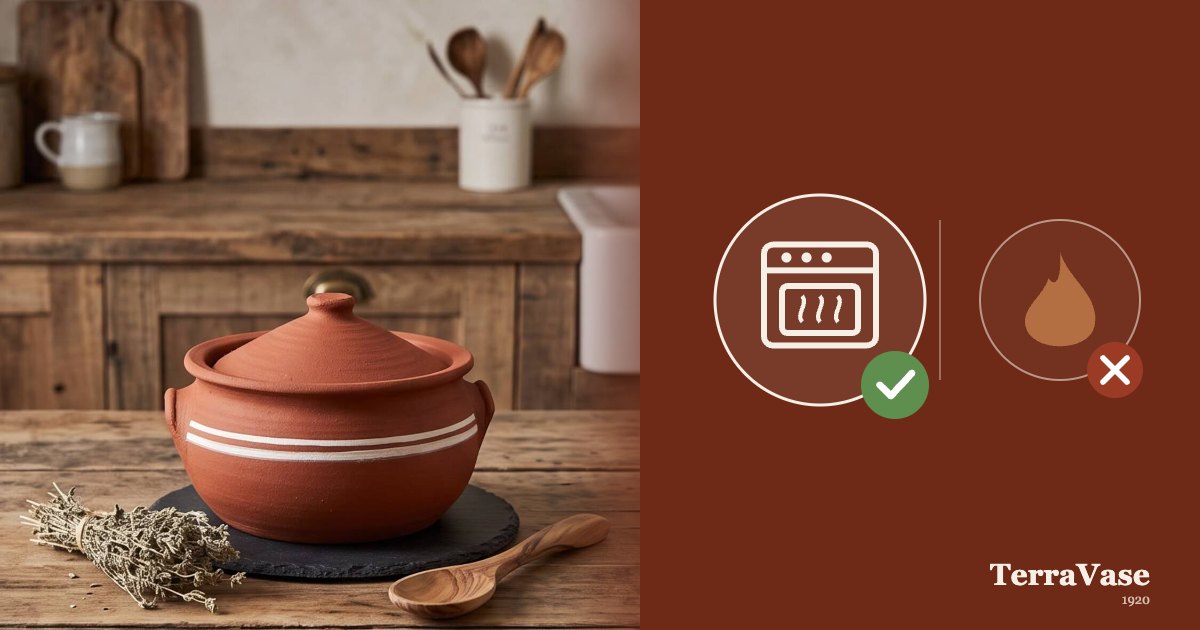
Our recommendation for TerraVase clay pots, trays and yogurt pots is clear: It is recommended to use them in the oven rather than over a direct flame. This recommendation also appears in the “Use and care” section of our product pages. A clay pot is made to be used with the even heat of an oven that surrounds it from every side.
Why the oven instead of the stove?
Localised heating and sudden temperature differences
On a stove, heat is concentrated only on the base of the pot, and often on just one part of the base. Clay conducts heat slowly. While the base heats up quickly, the sides and upper part of the pot stay cooler. Different parts of the same pot being at different temperatures creates stress in the material. Over time this stress can lead to hairline cracks or cause the pot to break.
In the oven, heat surrounds the pot from every side. Because the pot warms up slowly and as a whole, no sudden temperature difference occurs.
Glass-top and induction hobs
Glass-top hobs have a flat cooking surface and transfer heat to the surface in direct contact. As the base of a clay pot is handmade, it may not be perfectly flat, which means only some points of the base heat up. Induction hobs work with a magnetic field and do not heat clay pots at all. For these reasons we do not recommend using clay pots on these types of hobs.
Even heat distribution
One of the qualities that makes a clay pot valuable is that it distributes heat slowly and evenly, allowing food to cook over a long time in its own juices. This quality shows best in the oven. It is also why traditional recipes such as lamb güveç, türlü (mixed vegetable stew), white beans or baked rice pudding are cooked in clay pots in the oven.
Tips for using a clay pot in the oven
- Start with a cold oven: Instead of putting the pot into a preheated oven, place it in a cold oven and heat them together.
- Do not heat it empty: Do not heat the pot empty for a long time; put it in the oven together with the food you are cooking.
- Add hot liquids: If you need to add liquid while cooking, use hot water instead of cold water.
- Take care when removing it: Do not put a hot pot on a cold worktop, a wet surface or marble. Place a wooden trivet or a dry cloth underneath.
- Cool it gradually: Do not wash a hot pot with cold water; let it cool down on its own first.
- Do not use a microwave: Our clay pots cannot be used in the microwave.
Recommendations by oven type
Domestic electric oven
In a home oven, place the pot on the middle shelf. The top and bottom shelves, which are very close to the heating elements, can make one side of the pot heat up faster than the other. Fan programmes distribute heat more evenly inside the oven and can be preferred for clay-pot cooking.
Stone oven and wood-fired oven
Traditional stone ovens are where clay-pot dishes have been cooked for many years. In these ovens the pot should be placed not right next to the flame but in the area where the heat is even. The area near the oven mouth is usually cooler; letting the pot wait there first and then moving it further in helps it warm up gradually.
Commercial ovens
The same rules apply to the convection and steam ovens used in restaurants: avoid sudden temperature changes, do not heat the pot empty and do not place a pot straight from the oven on cold surfaces. We cover model and size selection for businesses in our “Clay Pot Buying Guide for Restaurants“.
Carrying the pot from the oven to the table
A clay pot stays hot for a long time after leaving the oven. Use a dry oven glove when carrying it; a wet cloth transfers heat quickly. When serving, place a wooden trivet or a thick cloth under the pot. At the table, take care not to place the pot next to cold drinks and not to pour cold liquid onto it.
Why does cooking in a clay pot take longer?
A clay pot conducts heat slowly. That is why dishes cooked in a clay pot usually take longer than the same dish cooked in other pans. This is not a disadvantage but a feature that gives clay-pot dishes their character: meat and vegetables cook slowly in their own juices. For this reason, restaurants often plan clay-pot dishes in advance and put them in the oven early. When cooking at home, we also recommend putting the dish in the oven earlier rather than raising the oven temperature to shorten the cooking time. High heat can make the outer surface of the pot heat up much faster than the inside and create a sudden temperature difference.
Storing your clay pot
After use, once the pot is completely dry, store it in a dry, airy cupboard with the lid slightly open. When stacking pots, placing a cloth or paper between them prevents the rims from rubbing against each other. Before using a pot that has not been used for a long time, simply rinse it with lukewarm water and let it dry.
First-use preparation matters too
So that the pot can be used in the oven without problems, it is recommended to oil it and cure it in the oven before first use. We explain these steps in detail in our article “How to Prepare a Clay Pot Before First Use“.
How can you tell if a clay pot is cracked?
Cracks that start as a thin line on the surface of the pot can widen over time. If tapping the rim lightly with your finger produces a dull sound, or if liquid you put in the pot seeps out, the pot may be cracked. We do not recommend cooking in a cracked pot.
Frequently asked questions
Can I use a clay pot on the stove over a low flame?
Our recommendation for our products is to use them in the oven rather than over a direct flame. Even a low flame creates localised heating on the base.
Can a yogurt pot go in the oven?
The product pages of our yogurt pots also recommend using them in the oven rather than over a direct flame, and oiling and oven-curing them before first use.
Can a pot straight from the fridge go into the oven?
Do not put a pot that has been in the fridge straight into a hot oven. Let it come to room temperature, or place it in a cold oven and heat them together.
Can I use a clay pot on a barbecue or grill?
Barbecues and grills apply direct, intense heat to the base of the pot. Our recommendation for our products is to use them in the oven rather than over a direct flame.
What should I do if stains appear on the outside of the pot?
Grease and food stains may appear on the outer surface during use. Once the pot has cooled, you can clean it with lukewarm water and a soft brush. Colour changes that develop over time are a natural result of using clay products.
Do the same rules apply to clay trays and pizza trays?
Yes. The same recommendations apply to our clay trays and ovenware: use in the oven rather than over a direct flame, wash by hand and do not use in the microwave.
Which dishes are cooked in a clay pot?
Meat and vegetable casseroles, pulse dishes such as white beans and chickpeas, türlü, shrimp güveç, baked rice pudding and baked pasta are among the dishes commonly cooked in clay pots.
TerraVase clay pots
You can find the traditional clay pot models of the Eskişehir, Salihli and Karacasu regions in different sizes in our Clay Pots and Casseroles category. You can send your wholesale supply request for your business through our Wholesale Quote page.